
Olive
A Tribute. One Month Later.

From My Table
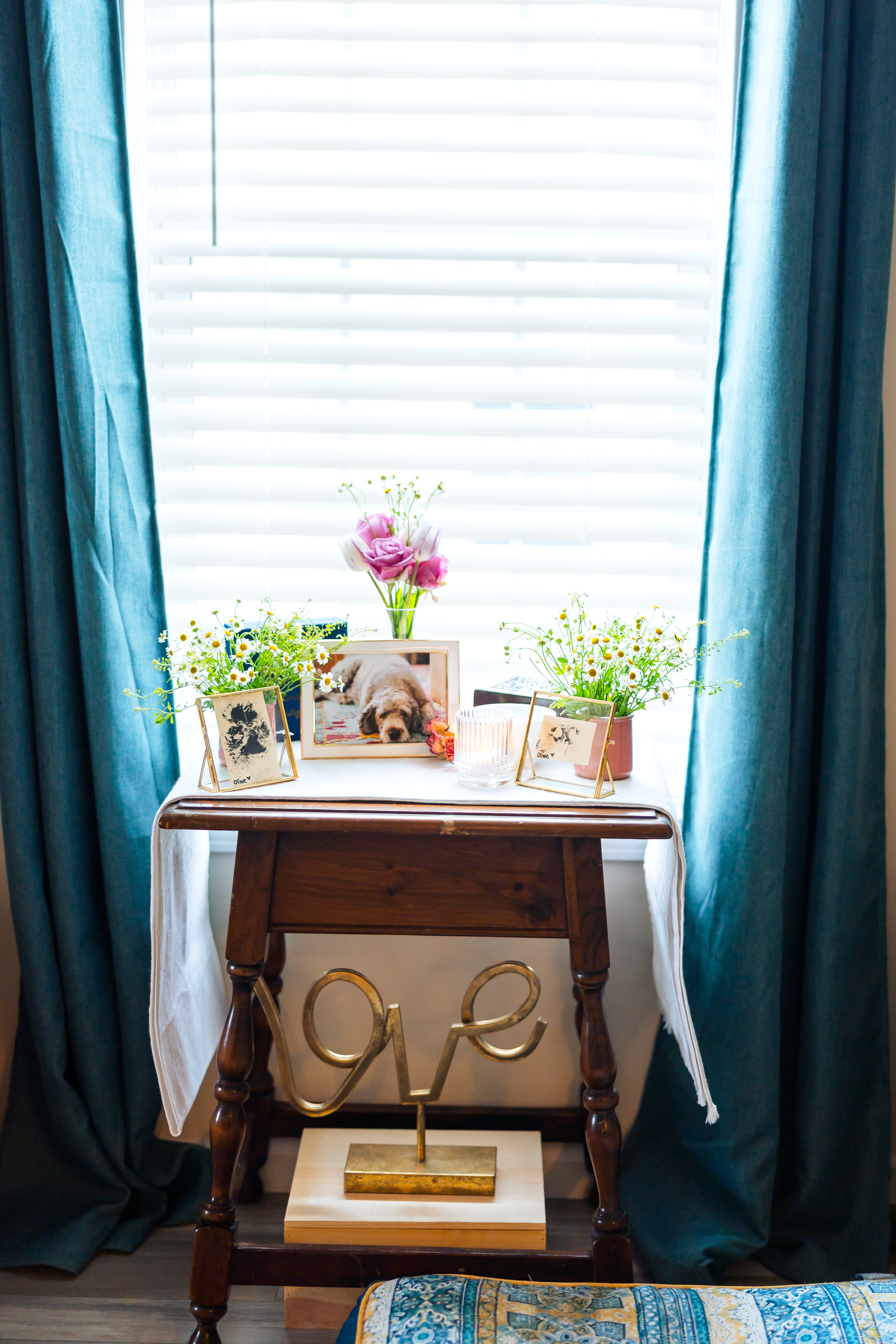
I am writing this from my couch, in the living room, the one that still holds the shape of ten years of her presence. I am looking at her altar — her ashes, her paw print and nose print pressed into clay, her photograph in a gold frame, flowers, a candle I light each evening. Behind me, incense is burning. I lit it with intention: to transmute the sadness in this air into something else. Into remembrance. Into gratitude. Into the particular tenderness that only arrives after you have loved something so completely that its absence becomes its own kind of evidence.
This is how I write her now. With smoke behind me and her face in front of me and the house still learning how to be quiet in a new way.
Olive passed on March 12th. Today marks one month.
Today’s thread carries:
the particular silence a beloved animal leaves behind, and what it means to love something that never once questioned whether you deserved it.
The One Who Arrived Knowing
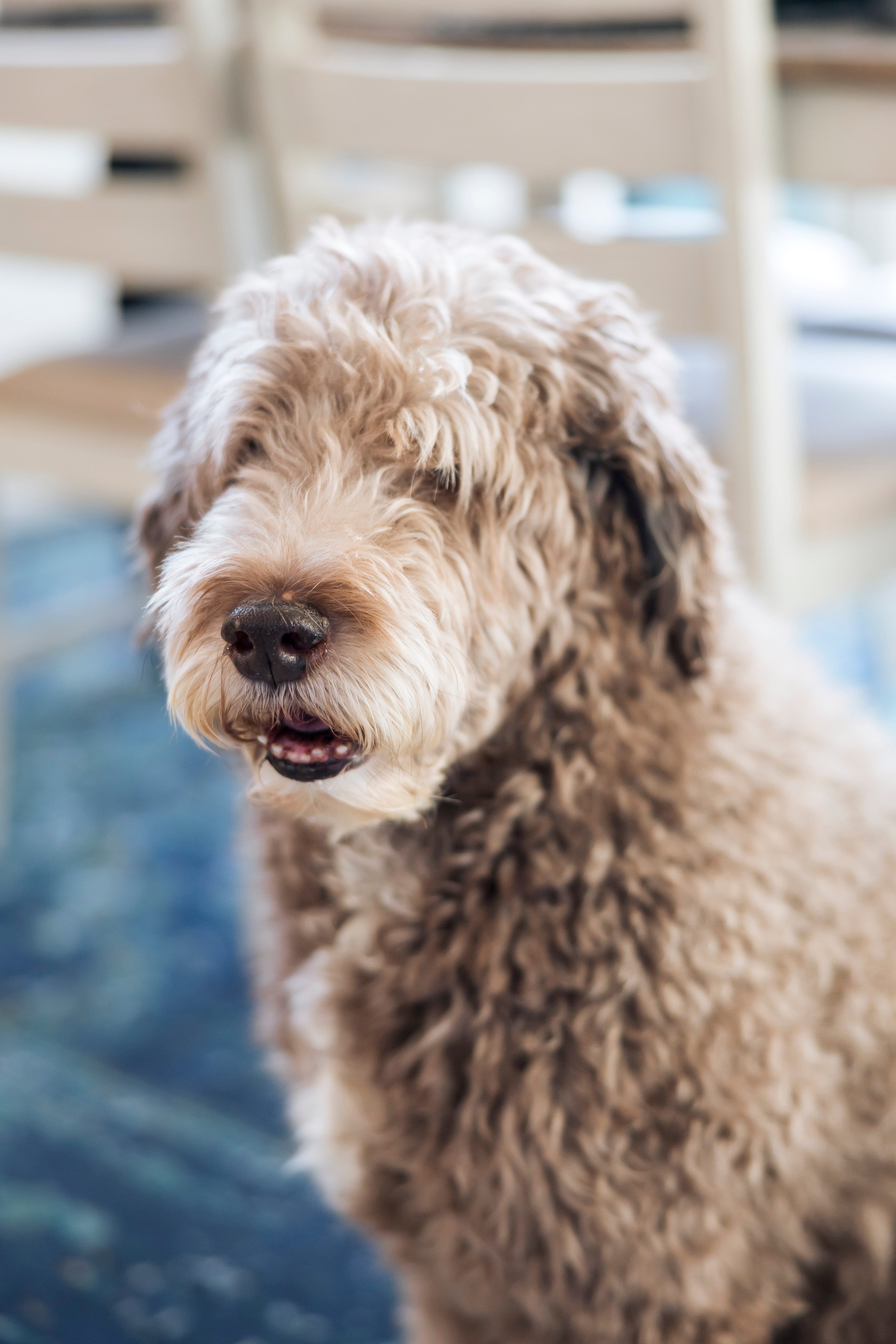
She came in 2015, already one year old, already entirely herself. Olive — silver-furred, unhurried, Australian labradoodle — came as my daughter Mia’s companion first. An emotional support animal, which is a clinical way of saying: she arrived because Mia needed to be held by something that did not require explanation. Something that would show up the same way every single morning regardless of the night before. She came because sometimes what a nervous system needs is another nervous system that has already decided everything is going to be okay.
She did that from the first day. She came in, found the softest rug in the house, and spread her whole body across it like she had always lived there. Like she had been waiting for us to figure out that she belonged here. We reorganized our lives around her without discussion. The way you do with love that arrives already knowing its own address.
Olive had opinions. This is the first thing anyone who knew her should understand. She had a highly developed inner life and a clear sense of what she would and would not tolerate. She was not a dog who performed enthusiasm. If she liked you, she greeted you with approximately forty percent of her available energy — a glance, a slow tail wag she seemed embarrassed to be caught giving, a studied indifference she maintained until you stopped paying attention, at which point she materialized beside you and pressed her full weight against your leg. She loved you on her own terms and her own timeline and she was not going to be rushed about it.
If you were patient enough to earn her affection and begin to pet her, she stayed. Completely. She gave herself over to it with the same total commitment she gave to sleep — until she had decided she was finished, at which point she simply stood up and walked away, leaving you mid-stroke with nothing but the memory of her.
There was one person in this house whose bed she claimed as her own. She adored him — fully, without the usual Olive reserve, without the studied indifference she offered most people as a first impression. With him, she skipped the performance entirely. She slept curled against him the way dogs sleep when they have decided that someone belongs to them at the cellular level. He was her best friend. Wherever he was, that was where she was. Whatever his bed was, that was her bed. She chose him the way she chose everything: quietly, completely, without making a fuss about it. And she stayed chosen until her last night in this house.
She had one natural enemy: the UPS truck. The FedEx truck. Any large delivery vehicle that had the audacity to travel down her street. She heard them from a mile away — before any human ear in the house registered anything — and she rose from her horizontal stillness with a velocity that was startling every single time. She placed herself at the window and she barked with a ferocity that suggested the trucks were a personal offense, a direct challenge, and an ongoing insult she refused to normalize. We never told her they were harmless. She would not have believed us, and honestly, she was right about something the rest of us had given up on: her territory deserved vigorous defense.
What the Body Knows
There is science behind what happened to us when Olive entered a room, and I find myself returning to it now as a way of understanding the scale of what we have lost.
When a human being strokes a dog, when the hand finds the fur and begins to move across it, the body releases oxytocin. The same neurochemical that floods a mother’s system when she holds a newborn. The same one that moves through us in moments of genuine safety and belonging. Cortisol levels in the blood begin to drop. Blood pressure follows. Breathing slows almost imperceptibly, following the rhythm of the animal’s own breath, which is something the body does automatically — a phenomenon called physiological co-regulation, where one nervous system borrows steadiness from another.
Olive was a co-regulator. She just did it in the form of a silver dog who sprawled like a throw blanket across the good rug.
My daughters would come home from a hard day and Olive would be there. She would find the girls without being called. She would press her body against their legs, or put her head in the available lap, and just stay. No interpretation, no advice, no assessment of whether the feelings were proportionate to the circumstances. She simply arrived and remained, which is one of the most healing things one creature can do for another. Science confirms it. The body knows it before the mind ever finds the words.
I watched this happen for years. I watched Olive regulate my daughters’ nervous systems, similar to a compass that orients to the north. Automatically. Without effort. As if this was simply what she was built for. Some animals come into a family with a specific kind of purpose that has nothing to do with tricks or commands. She came to hold us steady. She did it for almost a decade.
Motherhood on Her Own Terms
She also mothered two litters of puppies, which is its own kind of story.
The father was Deacon, a beautiful dog by all accounts, and one Olive also did not particularly like. This was consistent with her character. She had standards for who earned her genuine warmth, and Deacon, beautiful as he was, apparently did not clear the bar to her satisfaction. She tolerated him. She gave him the forty percent greeting. She mothered his puppies with the same complicated energy she brought to everything: fully, on her own terms.
Because Olive loved her puppies. She also did not particularly like them. This is a distinction that anyone who has ever loved something inconvenient will recognize. The love was real, total, without question. The enjoyment was another matter. She endured the litters with the expression of someone who has taken on a responsibility they respect but would not necessarily choose again. She retired from mommyhood after sitting on one of her puppies — not maliciously, simply with the conviction of a dog who had decided the floor was hers and did not consult the puppy first. We took the hint. She had given what she had to give, and she was ready to return to her primary vocation, which was horizontal stillness in rooms full of people she loved.
But when a different pup from her litters needed a blood transfusion, she showed up. She gave her blood calmly and completely, with the ease of a creature who understood that love is not the same as preference. She was a complicated mother. She was a faithful one.
Her best friend was Waffles — a purse dog, small enough to be carried, belonging to my best friend Chao, and apparently the only other dog Olive ever fully admitted into her world. Waffles was the exception. Waffles, she allowed. There was something between them that operated outside Olive’s usual social economy, some private understanding we were not privy to. They had their arrangement, and Olive honored it. That Waffles was family made it feel less like a surprise and more like Olive had decided, on her own terms, to extend the circle — slightly, carefully, to exactly one more.
Later in life she met Rigby, my daughter Bella’s dog. A puppy, full of the particular chaos that puppies carry — boundless energy, no concept of personal space, zero appreciation for the dignity of a senior dog’s queen bed. Olive was not impressed. She had spent years cultivating an atmosphere of measured calm in this house and Rigby arrived like a small, enthusiastic interruption to everything she had built. She was not a fan. She made this known in the eloquent way she made everything known: by leaving the room.
Without Conditions
There is something I want to say about unconditional love, which is a phrase we use casually and then forget to actually feel the weight of.
Olive did not love us because we were good. She did not love us because we were consistent, or because we always fed her on time, or because we were emotionally available on any given Tuesday. She loved us in the morning when the house was still and nobody was paying her any attention. She loved us after arguments. She loved us through the years that were hard, through the transitions and the losses and the ordinary accumulations of human difficulty that leave marks on a household. She held us in the same steady regard whether we were our best selves or our most tired ones.
That is the thing about a faithful animal. The love is not contingent. It does not recalibrate based on your output. It does not arrive with conditions buried in the fine print. Olive looked at you — chin on her paws, eyes dark and patient — and the message was always the same: Te veo. Estoy aquí. Con eso basta.
Most humans cannot do this. Most humans, myself included, love in the register of expectation. We love and we also hope the loving will be reciprocated in a particular way, at a particular volume, in a particular season. We love with our own needs threaded through the love, because that is what human love is — relational, which means it is always also about ourselves.
A dog carries no such architecture. Olive’s love was structurally different. It was pure orientation. She was oriented toward us the way sunflowers orient toward light — completely, without deliberation, as if there were no other option worth considering.
I am still learning what it meant to be loved that way. I think I will be learning it for a while.
La Guardiana
Loyalty is a word we throw at dogs the way we throw other words at things we love but haven’t fully examined. We say loyal and we mean something vague — something about the dog waiting at the door when you come home.
But I want to say it with more precision.
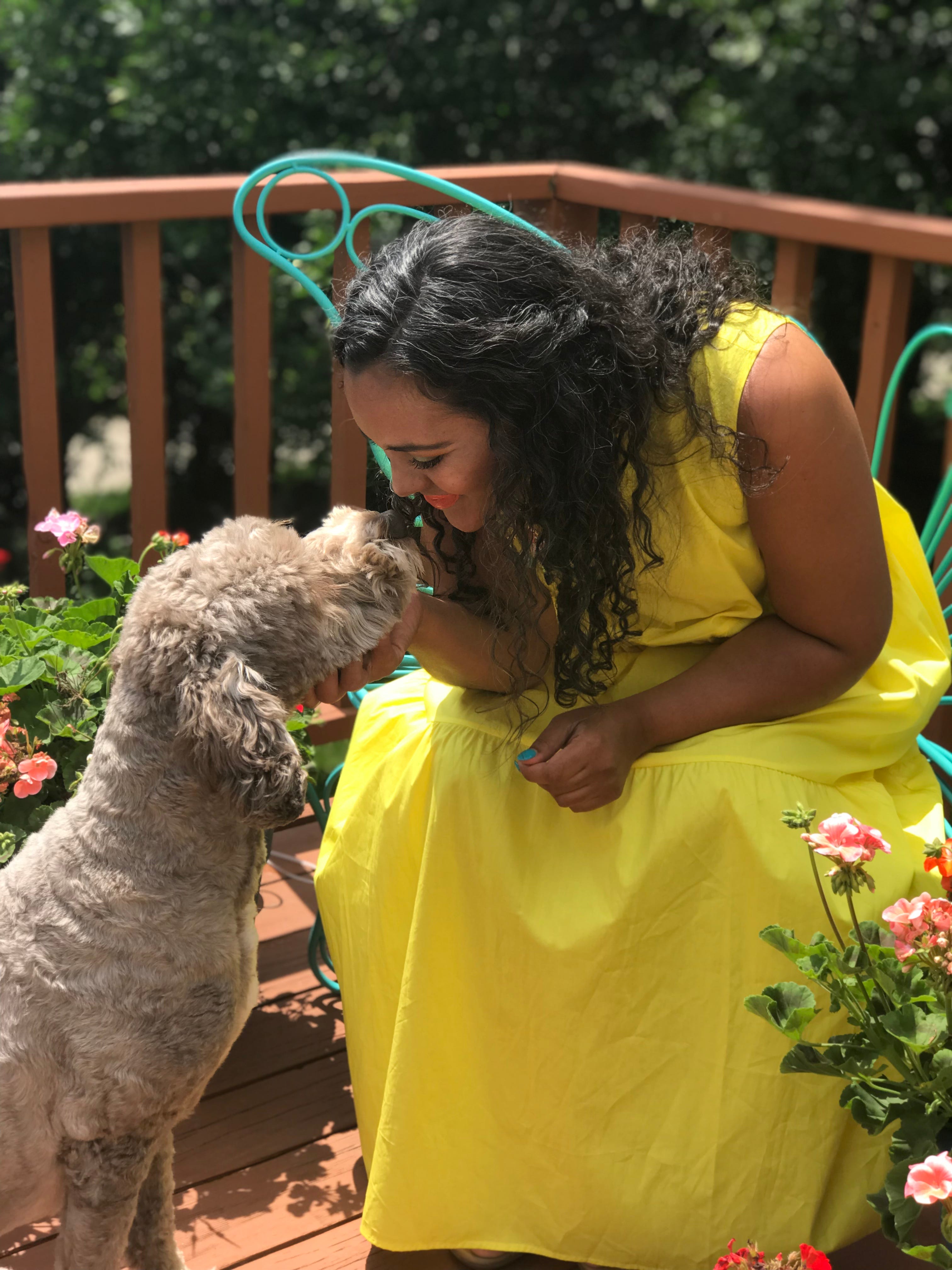
Olive was loyal. She was faithful in the way of a small god who has chosen her people and will not be argued out of it. Her bark — deep and certain, arriving from somewhere far below her body — was the bark of a protector. She had no particular physical intimidation to offer. But she planted herself between us and whatever she perceived as threat and she made herself enormous in the sound she produced, and she meant every syllable of it. The UPS truck learned nothing from her warnings. She never stopped giving them anyway.
She watched the door when someone knocked. She watched the yard at dusk. She watched whoever was crying to make sure they were still breathing. This was her work, and she took it with the kind of seriousness that has no ego in it — the seriousness of vocation.
She was faithful to us across ten years. Ten years of being the same dog every single morning. Ten years of finding the warm spot in whichever room held the most life. Ten years of being, without interruption, the most reliable presence in the house — even when that presence expressed itself as a slow tail wag she pretended not to be giving, or a body weight leaned into your leg while she gazed pointedly in the other direction, maintaining the fiction that she had wandered there by accident.
In a life that arrives in chapters and revisions, in a family that grows and grieves and rearranges itself, Olive was the constant. She was the one thing that was always the same.
I did not know how much I depended on that sameness until it was gone.
The Night of March 12th
The last six months came quietly. She was still eating, still sleeping with her total, all-in commitment to rest. The changes were small enough to miss if you weren’t paying attention in the particular way that love makes you pay attention. Her joints moved with more deliberation. The bark went still. One day it was there and then it wasn’t, and I noticed the absence the way you notice a clock that has stopped. The house was slightly different in pitch. The FedEx truck passed unmolested for the first time in ten years.
I knew what it meant. Somewhere below conscious thought, the body knew before the mind caught up.
On the night of March 12th, Olive had a seizure that did not stop.
Mia and I got her to the vet. I knew on the drive there. I knew the way you know things you have been quietly preparing for without realizing you were preparing — some deep animal part of me had been readying for this moment since the bark went silent, since her joints started asking her permission before she moved. I held the knowing and I held her and I made the decision to end her pain because that is the last act of devotion available to us when someone we love is suffering and we cannot fix it. We can only ease it. We can only stay.
We drove home to a house that had forgotten how to be quiet in a way that felt safe.
Love With Nowhere to Go
Someone once said that grief is love with nowhere to go. I have been sitting with that since March 12th, turning it over the way you turn over a stone to see what lives underneath.
The love did not stop. That is the thing I keep arriving at. The love that existed for ten years — the daily accumulated tenderness of living alongside this animal, of knowing her sleeping sounds and her moods and the particular way she materialized beside you the moment you stopped watching for her — all of that love is still here. It simply lost its address.
I walk through the rooms and feel the shape of where she was. The rug where she flattened herself with such commitment. The corner by the door where she positioned herself between us and whatever the street was doing. The warmth that a sleeping dog generates, which is a warmth you stop noticing until it is gone and then your body registers its absence before your mind does.
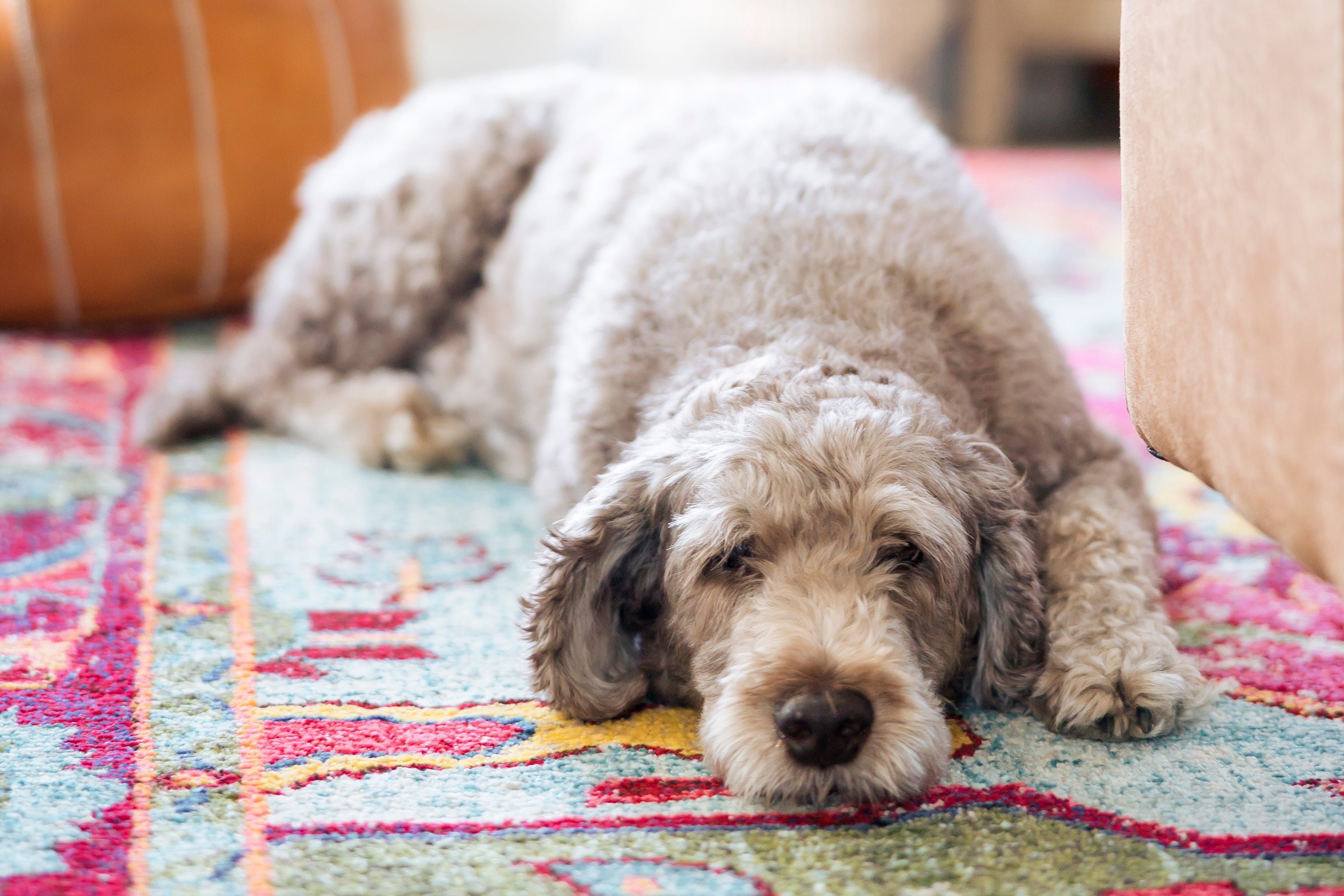
I made her an altar. Her ashes are there, and her paw print and nose print pressed into clay — the physical record of her body, the evidence that she was here and she was particular and she was real. A photograph in a gold frame: she is lying flat on the colorful rug, chin to the floor, looking directly at the camera with the expression of a creature who has made complete peace with exactly where she is. Flowers. Chamomile. Roses and tulips. A candle I light each evening. And behind me, as I write this, incense curling upward — because I need the sad air to become something else, because I need the remembering to feel like gratitude, because grief this tender deserves a ritual container.
And one day, some of her ashes will travel to Barcelona. We had a small invented mythology in this family: Olive always wanted to ride a bicycle through the streets of Barcelona. She never told us this directly. She was far too composed for that. But we knew. We will take her there. We will find good light and a good street, and we will let some part of her go into that city she spent ten years quietly dreaming of.
Que descanse en la ciudad que soñaba. Que el viento de Barcelona la lleve a donde sea que van las almas buenas.
She was not always an easy dog to know. She required patience, and she rewarded it slowly, on her own schedule, in the sideways manner of someone who loves you but will not be caught admitting it too easily. She walked away when she had enough. She came back when she was ready. She gave her blood when a puppy needed it and sat on a different one by accident, fell asleep against your leg, and heard the FedEx truck before any human ear in the house stood a chance.
We loved her well. I have to keep saying that. We loved her well, and she knew it, and she loved us back with everything she had — on her terms, in her time, without condition, without interruption, for ten years and one month and twelve days.
That is not a small thing.
That is, in fact, everything.
Benediction
May you know the particular peace of a creature who has chosen you completely.
May your nervous system find its rhythm in the warmth of something soft and faithful.
May the love that has nowhere to go find a container — an altar, a story, a street in Barcelona.
May grief arrive not as absence but as evidence of how fully you were loved, and how fully you loved in return.
May every home hold at least one thing that asks nothing of you except that you remain.
🌹
Un abrazo desde Casa Eva, “where beauty becomes ritual and ritual becomes home.”
Eva Glamaris
Reciprocity
If you have lived alongside a dog — or any animal who made themselves necessary to you in the way Olive made herself necessary to us — you know that their absence is not small. It rewrites the acoustics of the house.
I’d love to know: who has held that kind of space in your life? What did they teach your body about safety?
If this thread found you in your own season of loss — the particular grief of an animal, or any love that has gone quiet — I’d be grateful if you passed it forward. These words were written to be shared.
Eva I know the feeling too well unfortunately. Timber, a golden retriever passed much like Olive. Then we got Walden, an Australian Shepherd. He passed far too soon and left a giant hole in everyone who was touched by him. My father has dreams of the things he needs to let go, I believe it is his way of releasing what no longer serves him. He had a dream about the last dog which he told me about and it took everything in me to not cry as he was telling me. He told me he was doing siding on a house ( a job he used to do) and an old dog started walking toward him. The dog we knew never reached old age but he recognized this dog anyway and called out to him, the dog looked toward him and then turned around and walked away. My brother asked my dad what he thought it meant and he thought that it might mean we will get to see our current dog get old.
Beautiful article, pets always have this way of leaving such incredible weight in the air once they are gone. It is always something we try to prepare for but it always hits like a train. It is in fact part of the commitment we have to our pets. Her altar is beautiful, inviting other emotions other than the heaviness is a healthy way to remember her.